Breeding Tables
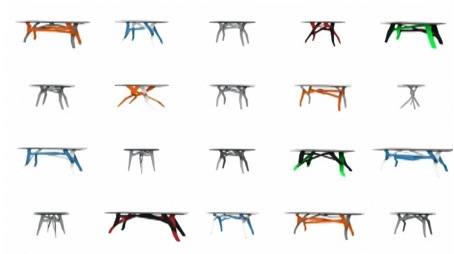
Abstract: The innovation process consists here in not designing tables but a software that designs infinite number of models of table with a standardized production process. Randomness is put at the hearth of design process.
The computer code creates lots of possible random variations, but the final defining pre-production choices are still made by humans. This is then integrated in a mass-production process: taking into account the specifications of parameters like height, depth, width and load capacity, these computer-generated cutting patterns and associated processing information orchestrate computer controlled laser cutters and bending machines, and seamlessly materialize three-dimensional corpuses.
Driver
Social
Growing trends of personalized/customised objects. Here, each table is different and unique…
Technological
A specific algorithm is the way all the process is possible/ lazer cutting technologies widely spread.
Economic / Industrial
According to the creators of breading tables, the project – completely outsourced process – is the best way to face fully integrated mass production to reduce costs (e.g. China model)
Design / Art
This method brings unpredictability and novelty to the field. Human choices and discernements are still a relatively big part
Indication
Potential “innovation wild card”
It represents a “first time”, in the “outsourced” design process of product in its ability to spread its philosophy to the production and acceptance of the resulting product.
Sector specifics / cultural specifics
This weak signal is specific to furniture design, potentially applicable to any kind of object production and customization.
Source
Internet
www.kramweisshaar.com/projects/breeding-tables.html
Magazine
Domus n.879, March 2005.